Writing
Sunday 22 January 2006


 A trip to the Falkland Islands
It’s only been two weeks of catching up on email, feeds, updating websites, fixing bugs, tidying up, plodding through to-do lists, having meetings and generally avoiding writing, and already the fortnight we spent in the Falkland Islands seems like months ago. Before more memories leak from my head here’s What I Did On My Christmas Holidays.
If you’ve heard of the Falklands, chances are it’s because of 1982’s Falklands War. I realised recently that, like many of my formative memories, there are grown adults alive now who weren’t even born when these things happened. So I guess there are people in the UK who haven’t heard of the place. Weird.
The first thing you’ll notice about the Falklands is that it’s a long way from London and a pain in the arse to get to. There are two practical choices. The quickest is to fly with the RAF from Brize Norton, an 18 hour trip including a two hour re-fuelling stop at Ascension Island, for around £1,600 return. While you won’t be sitting on a bench with a helmet and parachute, the planes still aren’t particularly salubrious. And the RAF is picky about flying conditions so you may end up waiting at a dull Brize Norton for way too long with little information.

The second choice, and the one we took, involves a much longer journey via Madrid, Santiago, Puerto Monte and Punta Arenas. While this is cheaper you need an overnight stay in Santiago or Punta Arenas to make the connections, turning the journey into a two day, three plane, ordeal. Either way it’s a trek and if you’re as much of a bleeding heart greeny as me, you’ll be trying not to worry about the enormous damage your lengthy flights are doing.
But hey, wake up! We’ve arrived in the Falklands now!
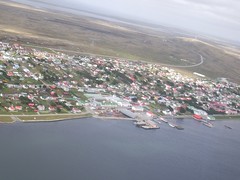
I was told the Falkland Islands are around the size of Wales, although this appears to be entirely wrong (Falklands: 12,173km2, Wales: 20,778km2). Still, it’s pretty big for the number of people there. Around 2,000 live in the capital, and only meaningful town, Stanley (which is never referred to as Port Stanley, despite us veterans of the 1982 media coverage remembering it that way). Another 900 or so live outside Stanley, this sparsely-populated countryside being referred to as “camp”. There are two main islands, East and West Falkland, and several smaller islands with a few people living on them. The military base at Mount Pleasant, thirty miles from Stanley, might have a couple of thousand people on it, but they rarely seem to leave the base. There are also a lot of sheep.
Conversations in the Falklands are peppered with acronyms: FIPASS, FIRS (formerly FIBS), FIDC, FIC, FIDF, FIGAS, BAS, MPA, BFBS, etc. Another bit of local lingo: Apparently when troops arrived there they referred to locals as “Bennies”, after the simple-minded chap in Crossroads. When they were ordered to stop using this term, the locals became known as “Stills”, as in “Still Bennies”. Although “Bennies” seems alive and well.
Enough of the Factbook, what’s the place like? Surprisingly nice actually. I didn’t know what to expect but the Falklands turned out to be more appealing than whatever I’d been expecting. We spent just over a week in Stanley between Christmas and New Year (thus getting the impression that no one does any work) and five days visiting Saunders Island and Sea Lion Island to see the wildlife.
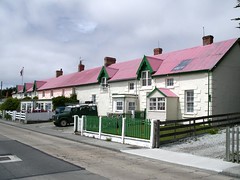
Stanley is small and, especially when the sun comes out, very pretty. There are cute houses, often white, maybe made of wood, with coloured roofs. Small, quiet roads. A view over Stanley Harbour and its picturesque wrecks. Green, hilly countryside all around. A few shops (groceries, souvenirs, not much else), pubs, a handful of places to eat (including a couple of very tasty restaurants, the Brassserie and the Malvina House Hotel). The town appears to be undergoing considerable expansion, with the graveyard that used to mark the eastern end of town now approaching the middle. I’ve never been to Scottish islands but Stanley, and the Falklands in general, are much like how I imagine them, in both look and feel.
Most of all it seems a very sociable place. No doubt social connections in any small town or village are pretty tight, but when it is as cut off from the outside world as Stanley, they must be stronger. It feels like everyone knows everyone else, particularly among those who grew up on the islands. As my dad said after visiting, at times it can be like being in the enclosed social world of a soap opera. On our last night we ate at the Brasserie and it seemed like the place was full of people we’d met over the previous fortnight, much like the limited social hubs (the Queen Vic, the Rovers Return) in any soap.
It may be that the lack of media helps make it a sociable place, making it feel even more cut off from the world. Newspapers sometimes find their way in via the planes but otherwise printed local news comes via the weekly black and white magazine Penguin News. Unless you subscribe to the limited satellite TV offering you’re stuck with a single BFBS “family” channel which broadcasts a selection of programmes from the UK terrestrial stations. Given the international and military nature of BFBS the weather forecasts are a surprise, covering Germany, Cyprus, the Balkans, Afghanistan, Gibraltar, Iraq and some place in Canada as well as the Falklands.
On the radio there’s BFBS’s two stations, one with popular music, the other with mainly talk and “classic”/classical music. Incidentally, someone told me that country music is big in the Falklands — if there’s a disco for school kids they want to dance to old country tunes rather than whatever’s in the charts. I have no idea why. There’s also the local, amateur-sounding, Falkland Islands Radio with music and local news/events.
It was only when I left the Falklands and reached Santiago that I realised one aspect of media that had been missing: advertising. I couldn’t recall seeing any outdoor ads and I think this is a major reason why Stanley feels so idyllic and calm. We become so used to our public spaces being polluted by companies selling us stuff that unfortunately it becomes normal. Go somewhere that is free of this constant shouting and you begin to realise the effect it has on you. It’s much easier to relax without it.
Which brings us to mobile phones. These are a new technology in the Falklands and the population is going through the usual social teething problems. They haven’t reached the point where most people have a mobile so the devices are still exotic and unnecessary items that owners feel they must justify. People can now turn up to appointments late because they can call at the last minute to apologise and schools wonder whether to ban mobiles.
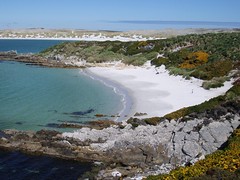
But enough of the big city living. Outside Stanley, camp is a remarkably beautiful place. My only mental image of the Falklands countryside was of soldiers yomping across cold, bleak rocks. But, particularly when the sun’s out (the war was in winter), there are some great sights. Clear, blue seas, sandy coves, picturesque hills to climb. And, perhaps best of all, wherever you are there’s hardly anyone else around. Although we were there in summer it did get pretty cold at times. The Falklands are a similar latitude to London, but the wind is pretty constant and conditions change rapidly.
But you’re unlikely to travel to the Islands solely for the landscape. I’ve never been one for animals and birds but I was won over on this trip and we met plenty of people who’d travelled around the world to photograph the Falklands wildlife. We saw an awful lot of penguins: Gentoos running in and out of the sea; Magellanics popping out of their burrows; King penguins standing around looking elegant; and Rockhoppers jumping up and down cliffs and coming up close to investigate. There are many other kinds of birds to see — albatross, oyster catchers, cormorants, etc — but you can’t beat watching hundreds of penguins from a few feet away.
Being able to sit and watch seals was also amazing. Forget cute little sad-eyed baby seals. Seeing a group of huge elephant seals throwing their weight against each other on the beach in front of you is quite a sight.
It’s possible to walk from Stanley to see penguins but for the the best experience it’s a bigger journey. There are several flights each day from Stanley’s small airport to the other islands in small eight-seater propellor planes which deliver great views if you’re not, ahem, busy throwing up. (I didn’t do well and in the few hours it took me to recover it appeared that everyone on West Falkland had heard about Sue’s brother and his flight.) The planes form another part of the close social fabric, shuttling people, mail, farm produce and other items around the remote settlements.

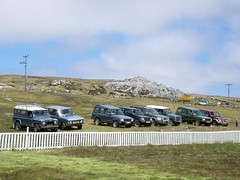
In camp roads are patchy. There are a couple of paved or gravel roads, although driving them at night must be a fearsome experience. Otherwise you’re on muddy tracks or, to get to some of the best places to see the sights, simply off-roading across the rocky, boggy, lumpy landscape. Consequently everyone, in and out of Stanley, drives a 4x4. I don’t mean “everyone” in the sense of “simply everyone drives an SUV these days darling!”. I mean it really is rare to see a vehicle that isn’t a Land Rover or some curvy Japanese variant. I was frequently amazed by what Rovers (as they’re known) could get over or through and I have fallen in love with their stubbornly boxy and practical shape.
The islands are well set-up for tourism. The major wildlife spots have very comfortable catered lodges or self-catering homes among the farm buildings. Cruise ships stop in occasionally, and Stanley will transform suddenly and briefly when a crowd of tourists in matching jackets come ashore for a few hours. Most of the Islands’ economy is based around sheep and selling fishing rights however, with oil exploration a possible future source of income.
As you might expect the Falklands are a very British place in that slightly old-fashioned, expatriate kind of way. Queen Elizabeth II is on the money, much of the food in the stores comes from Tesco or Waitrose and most of the inhabitants’ closest links are with people in UK (never “the UK” for some reason). I can’t help thinking it must be one of the least sustainable ways to live in the world: It takes at least one flight to get anywhere, never mind the number of flights to get back to the UK; Almost everything must be imported, usually from the UK (and how far did it already travel before arriving in the UK?); Everyone drives their 4x4s everywhere, even just round the corner. Having said that it feels like a “small”, “light” or simply easily old-fashioned way to live, particularly to this Londoner: Stanley’s small enough that you can just pop round to friends’ houses; There’s little consumerism (what would you buy?); The countryside is just next door. I fear this is a seductive illusion of self-sufficiency however.

Before I went I couldn’t tell why someone would choose to live there but it didn’t take long before I could see the appeal. If it wasn’t so arduous (and expensive) a journey a part of me would be tempted, as a drastic way to escape the real world. Well, maybe if they had broadband.
More:
- My photos at Flickr
- “Official” Falkland Islands website
- Unofficial website?
- Falkland Islands at Wikipedia
- Falkland Islands at Wikitravel
Some sites linking to this entry (Trackbacks)
Phil in the Falkland Islands
My friend Phil spent his Xmas break in a location I haven't thought about since 1982, Falkland Islands. I have no idea what goes on there--I imagine sheep and puffins shivering in some southern sleet--so I was excited when Phil...
At 'Stone Cold Pimpin'' on Sunday 22 January 2006, 8:45 PM
Comments
Funny about the lack of ads. It's the same in Libya - only place in the world I've seen no hoardings for cornflakes, Tall Toad beer etc. Of course you *do* get beaming pictures of the Great Man everywhere, but that's not quite the same. Or maybe it is - "Drink Qaddafi and you'll feel great and have lots of girls!" Hmm. Has a certain style. I like it. We'll go with it.
Re: Wales...
I think what we generally say is that the landmass is about half the size of Wales, spread over an area the size of Wales. I've never checked though...
This is a very informative travelogue. You've just about filled the tiny void in me to learn something about this destination. I'm going to view the photos now.
Great information on the Falkland Islands! My son is doing a research project about the islands and I found your travelogue to be very useful. One aspect about the islands that I am having difficult finding, however, is its cuisine. My son is supposed to bring in a dish for the whole class to share that is distinctly from the islands. Can you tell me a little more about the food and/or any ideas of what we could cook up for the class? His project is due on April 24. Thanks.
I only just noticed your comment now, sorry. I'm not sure what a typical meal would be, except that you should probably include lamb -- it's one of the few foodstuffs grown natively!
This all sounds very familiar. I endured the RAF from Brize Norton down via Ascension to the Falklands just before Christmas (3 day delay!), and found it really friendly, if slightly surreal.
I was down there installing broadband for those nice chaps @ Cable & Wireless, so watch this space :-)
Thanks for some good info! I've always wanted to visit the place to see for myself the rigors of island life.
Spent two years in Hawaii,so It does get old after awhile. But the place sounds great except for the winds
Again thanks
please as a Nigerian how can i vist the Falkland Island.pls give me more information on this, thanks i look forward to hear from you soon.
HI IF I WAS TO VISIT THE FALKLANDS ? HOW MUCH WOULD IT COST ? AND HOW LONG DID IT TAKE YOU BOTH WAYS ?? I'M REALI INTERESTED IN THE HISTORY AND KEEN TO GO, ITS FASINATING JUST TO KNOW THE UK PROTECTED THESE LITTLE ISLANDS MILES FROM HOME WHEN I WAS 2 YEARS OLD IN THE 80'S !!MAKES ME REALI PROUD TO BE BRITISH AND KEEN TO GO AND SEE THE ISLANDS!! WHICH TRAVEL COMPANY DID YOU USE ??
good story, thanks man for such informatian, I couldnt stop reading, I prefer you to try and to write more even books why not.
best regards
Bujar
Republic of Kosovo
East Europe
Hi Phil,
Good to read about your travels to FI. I'm temping at Morrison Construction who have an office there, so I feel like I've got to know the south Altantic a little bit. We build things mainly for the South Georgia and FI Governments as well as the British Antarctic Survey.
Cheers
Stanley does have broadband now, but at £99 and a 3GB download limit, it ain't cheap. www.cwfi.co.fk/index.p…
I suppose the trade-off is that you can use the internet connection to make phone calls, thereby avoiding having to pay £1 a minute to call the UK.
I found this site by chance. Nice site and very interesting reading.
I was part of the Task Force here in 1982 and returned again in 1983 for a few months. The question somebody posted about local cuisine....
I do remember in 1983 that the locals were all very friendly and quite often you would find a leg of mutton or some potatoes or vegetables on your doorstep. I was befriended by a lovely man who was a Falkland Islander - Terry Peck. He had been a local policeman before the Argentinians arrived - and had been awarded the MBE for his services to the British Task Force in the liberation of the islands. I believe that he later moved to the UK. Sadly also I believe he died last year. But when I was there - I had the pleasure to be invited to dine on a number of occasions with Terry. As I remember - on every occasion the meal consisted of mutton and potatoes roasted slowly in an Agga cooker. We used to wash this down with quite a few beers. Don't know if that particularly helps with the question about cuisine - I hope it does in some way. But that is what I remember the cuisine being.
Best regards
Tom
Hi, im a bennie myself and i think this is a great description of what the place is really like. I imagine it would be difficult for anyone to imagine what the place is like before they've spent a bit of time here.
I would disagree with second to last paragraph however about it being unsustainable. As a person who lives on one of the remotest farms on West Falkland, for the most part we do get 'stores' like Tesco and Waitrose, but sometimes this just isn't possible because there simply is no way of getting them there. This is really where it shows that they are extras that aren't essential t all because we haven't died of hunger yet!
Also, about driving our 4x4s everywhere, i do agree that people are slowly becoming more lazy, but isn't that the same all over the world? I also think that in Stanley, although there would be a lot of uproar, that it is still a small enough place that if it came to it, everyone would be able to give up driving everywhere.
Other than that I think this is really good and the more people read it the better - that way I may stop getting all these inbred and sheep shagger jokes while in in the UK!!
Thanks for doing this.
Hi Drew,
I will be arriving in mid-January. Will the island take US dollars? I'm looking for a local to take me to view nature and penquins as I do not going with tour groups. Can you assist with this in any way? Feel free to email me directly at fun2live@prodigy.net
I have been to FI twice - to inspect some equipment at Mount Pleasant Airfield. Now my wife has roped me into giving a talk about it, so thanks for this report. Only journeyed to Stanley once on each trip, so your info very valuable. Couple of things not mentioned by anyone - geese and landmines. MPA has a substantial resident population of geese and i would assume by such place names as Goose Green that these birds live throughout the islands.
On my first arrival (2001) at MPA terminal a severe looking military chap warned visitors "not to throw rocks into the mined areas". However in 2006 there was no such warning, so maybe most have been cleared away.
The road from MPA to Stanley is about 25 miles long, built in 1984 and permanently maintained by Islanders in very good condition. However due to severe winds on the FI it is liable to be closed for indeterminate periods.
Thanks for the thoughts Eddie.
There were still marked mined areas when I was there in 2006 and a few weeks ago I heard something on the news about how the UK was going to get in trouble with some international agreement to remove landmines, because of those still in the Falklands.
But months earlier I heard something about how the Islanders weren't that bothered about the mines, as the areas are all clearly marked, and wouldn't it be better to spend the money on clearing areas of the world where mines are dangerous.
Well, I'd love to visit the Islands known as Falkland. I like the language that people speak there. But what I'm finding out is how much is the trip to go the the Falkland? You will ignore me 'case i am argentinian but I don't care about that awful war. I love England more than my country...So, Tell me the price of it if you want to!
Love,
Enzoo (half English (l) and the another half Spanish)
Reply or add me enzo_prozzille@hotmail.com (Y) Nice to talk to yuo
Came across this site as I was speaking to a girl from Falkland today who's jaw dropped when I mentioned I had drunk beer in France! When I gave her a confused look she explained she was from Falkland, ( I am a mature student in Swansea, Wales). I do have some knowledge of the island as I have sold motor gasoline for export to Port Stanley. It is a bit unfair to state that the lifestyle is unsustainable, especially as I have just been to the supermarket and am able to buy spring greens, grapes, capsicums and God knows what else and it is October here in the UK! Similarly, I can't remember the last piece of clothing I bought that was manufactured within Europe.....
Good to read about life in the Islands. What does the local accent sound like? And are there are any recordings of musicmade by locals?
ta
SF
Exceptionally beautifull your web-site , your photo's , everything!
And one more thing: thank God that there aren't politicians like here in Romania! If I could , even tommorow I would try to fit in these Falkland Islands! And the wind I don't think is THAT BAD, considering that this means MORE AIR , fresh air to breathe! Come to Bucharest and in a month the most you would have breathing problems...
Falkland Islands would be the place to run away from this aberrant world that is getting worse by the day...
Thank you for this description of these Islands!
Gabriel from Romania!
Commenting is disabled on posts once they’re 30 days old.